
How Does a Stretched Fabric Acoustic Ceiling Work?
A stretched fabric acoustic ceiling can look like a simple decorative surface, but buyers often discover too late that appearance alone does not solve echo, speech clarity, or room-noise problems. This confusion can lead to unsuitable specifications and costly changes. I help B2B buyers assess the full ceiling system before they purchase.
A stretched fabric acoustic ceiling works by absorbing part of the sound energy that enters the room rather than reflecting it back into the space1. In most effective designs, a perforated stretch membrane, an air cavity behind it, and sometimes an absorbent backing work together. The perforations and cavity create resonance and friction, while the flexible membrane adds damping. Performance depends on the complete installed system, not the membrane alone.2

A buyer should therefore ask more than “Is this ceiling acoustic?” I recommend asking which frequencies need treatment, how much cavity depth is available, whether insulation can be added behind the membrane, and what documentation supports the proposed configuration. These questions turn an attractive ceiling finish into a more informed acoustic procurement decision.
What Is a Stretched Fabric Acoustic Ceiling Designed to Do?
A noisy restaurant, office, meeting room, or hotel lobby can feel unfinished even when the interior design looks excellent. Hard floors, glass walls, and exposed surfaces reflect sound repeatedly. This creates echo and speech confusion. A stretched fabric acoustic ceiling can help reduce reverberation when it is selected as part of a suitable acoustic system.
A stretched fabric acoustic ceiling is mainly designed for sound absorption, which reduces reflected sound and reverberation inside a room. It is not automatically a soundproofing product.3 Perforated membranes, air cavities, and optional acoustic backing materials can absorb sound energy, especially when the system is designed around the room’s acoustic needs.

Sound Absorption Is Not Soundproofing
In customer conversations, I often hear two terms used as if they mean the same thing: soundproofing and sound absorption. They solve different problems.
Soundproofing aims to reduce sound transmission from one room to another. A soundproof wall or ceiling assembly may need mass, airtight construction, structural separation, sealed penetrations, and carefully designed junctions4.
Sound absorption aims to reduce the amount of sound that bounces around within the same room. It can make speech clearer, reduce harsh echo, and improve comfort in active spaces.
| Question | Sound Absorption | Soundproofing |
|---|---|---|
| Main purpose | Reduces echo and reverberation in a room | Reduces sound transmission between spaces |
| Typical concern | Restaurant noise, speech clarity, office comfort | Noise from adjacent rooms, floors, or external sources |
| Common materials | Perforated membranes, porous absorbents, acoustic panels | Dense layers, insulation, resilient systems, airtight seals |
| Is a perforated membrane enough? | It can contribute within a designed system | No, perforations alone do not create a sound barrier |
For example, a retail store may have a high ceiling, ceramic floor tiles, glass storefronts, and painted gypsum walls. The owner may complain that customers cannot hear staff clearly. In this case, sound absorption may be the relevant goal.
However, if a hotel guest complains about hearing activity from the room above, the project team needs to assess the entire floor or ceiling construction for sound insulation. A perforated stretch ceiling may be part of the interior finish, but it should not be treated as a stand-alone soundproofing solution.
Why a Plain Stretch Ceiling Is Not Automatically Acoustic
A standard matte, satin, glossy, or printed stretch ceiling may provide an attractive and practical finish. It can offer moisture resistance, easy cleaning, lighting integration, and design flexibility. Yet a plain non-perforated membrane does not automatically provide meaningful broad acoustic absorption5.
The membrane’s flexibility may create some damping effect, but buyers should not assume that any stretch ceiling performs like a dedicated acoustic ceiling. In my experience, this is one of the most common misunderstandings during early project discussions.
I encourage procurement teams to request clear answers to these questions:
- Is the membrane perforated or non-perforated?
- What is the perforation pattern, including hole size and open-area ratio?
- What cavity depth will exist behind the membrane?
- Is an acoustic fleece, mineral wool, PET absorber, or another backing material included?
- Does the supplier provide test documentation for a comparable installed system?
- Are the test conditions relevant to the intended project configuration?
A product sample can show surface quality and perforation appearance. It cannot, by itself, prove how the complete ceiling will perform after installation.
How Does a Stretched Fabric Acoustic Ceiling Absorb Sound?
Many buyers expect an acoustic membrane to “trap” sound in the material. The actual process is more useful to understand than that simple description. Sound travels through air as pressure changes and vibrations. A stretched fabric acoustic ceiling absorbs some of this energy by making air, membrane structures, or porous materials move and lose energy through friction.
A stretched fabric acoustic ceiling can absorb sound through porous absorption, resonant absorption, and membrane damping. In perforated ceiling systems, the holes and air cavity create a resonant absorber. The moving air loses energy through friction, while the flexible membrane and any absorbent backing can broaden or improve the overall acoustic response.

1. Porous Absorption: Friction Inside Small Spaces
Porous absorbers include materials with many interconnected small spaces, such as certain acoustic mineral wool products, polyester fiber materials, or acoustic fleece. When sound waves enter these materials, the air moves through tiny passages.
That movement creates friction. A small amount of the sound energy becomes heat.6 The temperature change is extremely small, but the energy loss is enough to reduce reflected sound.
Porous absorption is commonly helpful for mid and high frequencies.7 Its effectiveness depends on factors such as:
- Material density and airflow resistance
- Material thickness
- Position relative to the sound source
- Air space behind the absorbent layer
- Frequency range being addressed
In a stretch ceiling assembly, the porous material may sit behind the perforated membrane. The perforations allow sound energy to reach the backing material. This is why a perforated membrane plus suitable backing can behave differently from the same membrane installed over an empty cavity.
2. Perforated Resonant Absorption: Holes and Cavity Working Together
The central principle behind many perforated acoustic stretch ceiling systems is perforated resonant absorption.
A perforated membrane contains many small holes. Each hole acts somewhat like a narrow neck through which air can move. The air cavity behind the membrane acts like a spring.8 When sound reaches the surface, air moves through the perforations and vibrates within the cavity.
At certain frequency ranges, this air movement becomes stronger. The vibrating air encounters resistance at the hole edges and within the system. Friction converts part of the sound energy into a very small amount of heat. This reduces the sound reflected back into the room.
This behavior is often compared with blowing across the top of a bottle. The bottle opening and bottle volume together affect the sound produced. In an acoustic ceiling, the perforation geometry and rear cavity influence the frequency range where resonant absorption is strongest9.
Several variables matter:
| System Variable | Practical Effect on Acoustic Behavior |
|---|---|
| Hole diameter | Influences airflow resistance and resonance behavior |
| Perforation density | Changes open area and how much sound can enter the system |
| Membrane thickness | Affects the air path through each perforation |
| Cavity depth | Influences resonance and can improve lower-frequency absorption |
| Backing absorber | Can add porous absorption and broaden the effective range |
| Membrane tension | Can influence vibration and damping behavior |
| Installation quality | Affects cavity consistency, edge details, and final system behavior |
A useful procurement point is that smaller holes do not automatically mean better acoustics10. In some system designs, smaller openings and higher airflow resistance can help shift resonant behavior toward lower frequencies. However, hole size must be evaluated together with perforation density, membrane thickness, cavity volume, and backing material. A supplier should not make a universal claim based on perforation size alone.
3. Flexible Membrane Damping
A stretch membrane is flexible. When sound energy reaches it, the membrane can vibrate slightly. That vibration can dissipate some energy through damping.
Membrane damping should not be treated as a replacement for a properly designed absorption assembly. Still, it can contribute to the overall acoustic behavior of the system. The membrane’s tension, mass, and the cavity behind it all affect how it responds.
I have seen buyers focus only on the visible perforations. The perforations matter, but the membrane itself is also part of the system. This is one reason why replacing a specified acoustic membrane with a visually similar product can create performance risk.
Why Does Air Cavity Depth Matter in a Stretched Fabric Acoustic Ceiling?
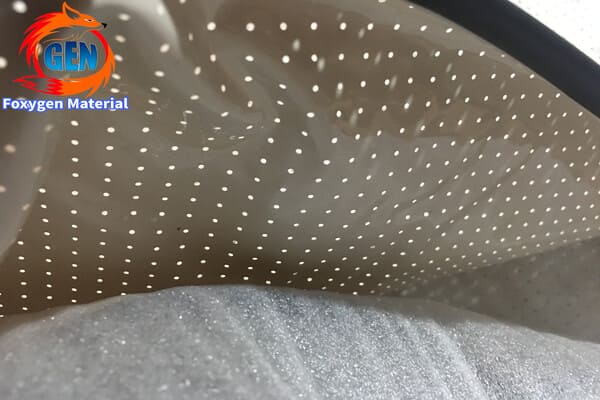
A ceiling may use the same perforated membrane in two different projects, yet deliver different acoustic behavior. The reason is often hidden above the surface: the available air cavity. A shallow cavity can limit the system’s low-frequency effect, while a deeper cavity changes how the perforated membrane and enclosed air respond.
Air cavity depth matters because the space behind a stretched fabric acoustic ceiling acts as part of the resonant system. A deeper cavity generally supports absorption at lower frequencies11 and can improve the effectiveness of added porous backing. The right depth depends on the room, target frequencies, construction limits, and complete ceiling design.
A Deeper Cavity Is Often More Valuable Than Extra Surface Material
Low-frequency sound has long wavelengths. It is usually harder to absorb than high-frequency sound.12 Simply adding a thin decorative acoustic layer often does not solve low-frequency reverberation concerns.
A deeper air cavity gives the system more volume for air movement and resonance. In practical terms, this can help the ceiling assembly address lower frequency ranges more effectively than a very shallow installation.
This does not mean every project needs the deepest possible void. Ceiling height, lighting, HVAC coordination, sprinkler placement, access requirements, and budget all affect the available depth. However, buyers should understand that reducing the cavity depth to save space may change the acoustic outcome.
For a project with strict ceiling-height limits, I suggest discussing options early with the installer, designer, and qualified acoustic professional. They may compare:
- A perforated membrane with a shallow cavity
- A perforated membrane with a deeper cavity
- A perforated membrane plus acoustic backing
- A combination of ceiling treatment and wall-mounted absorption
- Localized acoustic islands or zones instead of full-ceiling coverage
This approach often produces a more practical solution than expecting one material to solve every frequency issue.
The Importance of the Complete Assembly
A perforated stretch ceiling is not a single product decision. It is an assembly decision. The visible membrane is only one layer.
For B2B purchasers, I recommend defining the specification in a way that includes the full system:
- Membrane type: PVC stretch ceiling membrane or another specified stretch material
- Surface finish: matte, satin, printed, translucent, or another design requirement
- Perforation configuration: hole pattern, diameter range, and open-area requirement
- Installation profile: wall-mounted, ceiling-mounted, or specialty profile details
- Cavity depth: target installed distance from structural soffit to membrane
- Acoustic backing: type, thickness, density, and fixing method where applicable
- Service coordination: lighting, vents, sprinklers, inspection access, and wiring
- Evidence: test reports, specification sheets, and project-specific drawings to verify
At Foxygen, we supply perforated stretch ceiling films, profiles, accessories, and related system components for project-based requirements. We can also support customization of membrane size, finish, printed pattern, packaging, and certain system details. Still, I always recommend that buyers verify the relevant test documents and involve qualified acoustic consultants when the project has defined acoustic targets.
A Practical Consultation Example
I remember a preliminary discussion with an installation contractor working on a hospitality space. The team initially asked for “acoustic film” because guests found the room lively and loud. After further questions, we learned that the ceiling void was limited, the room included many hard surfaces, and the main issue was speech comfort during dining hours.
The right next step was not to promise a single performance number. The project team needed to clarify the ceiling cavity, the perforation option, the possibility of backing material, and the role of wall finishes. That is the kind of information that reduces procurement risk before the order is placed.
How Should Buyers Specify and Evaluate a Stretched Fabric Acoustic Ceiling?
A buyer can select a visually appealing ceiling and still face avoidable issues with installation, material consistency, or acoustic expectations. These risks grow when a project specification says only “acoustic stretch ceiling” without defining the membrane, cavity, backing, and installation conditions.
A stretched fabric acoustic ceiling should be evaluated as a project-specific system. Buyers should compare membrane perforation, air cavity depth, backing materials, installation details, documentation, production consistency, and supplier support. Qualified acoustic evaluation is advisable when a project requires measured acoustic targets or complex room analysis.
Start With the Room Problem, Not the Product Name
The first question should be: What problem does the project need to solve?
Common buyer objectives include:
- Reducing echo in restaurants and cafes
- Improving speech clarity in offices and meeting rooms
- Creating better comfort in hotel lobbies and banquet spaces
- Managing noise buildup in retail stores
- Combining an illuminated ceiling design with acoustic treatment
- Improving the acoustic character of exhibition or entertainment spaces
Each objective may require a different balance of perforation, backing material, coverage area, and cavity depth.
A large open office may need broad control of speech reflections. A restaurant may need absorption across several surfaces because tables, glass, and flooring are highly reflective. A meeting room may require more careful analysis because speech privacy and intelligibility can involve different acoustic priorities.
Request Comparable Documents, Not Generic Statements
When a supplier presents acoustic claims, I suggest that buyers request the supporting documents and inspect whether they apply to a comparable system.
Useful questions include:
- Was the test completed on the same or similar perforated membrane?
- Did the test include a cavity? If yes, what depth?
- Did the tested assembly include insulation or acoustic backing?
- What mounting method was used?
- Which testing standard and laboratory were involved?
- Does the report describe the complete sample construction?
- Is the intended project configuration materially different from the tested system?
Certifications, laboratory reports, and compliance documents should be treated as documents to verify, not as broad guarantees for every installation. The same principle applies to fire, environmental, and material-performance documentation.
Evaluate Supplier Capability Alongside Product Design
For installers, distributors, and fit-out contractors, the supplier’s operational capability can affect project results as much as the membrane selection.
| Evaluation Area | Why It Matters |
|---|---|
| Batch consistency | Helps reduce visible shade differences across large ceiling areas |
| Custom cutting accuracy | Supports installation efficiency and reduces site waste |
| Perforation quality | Supports consistent appearance and system design intent |
| Packaging and labeling | Helps installers identify rooms, zones, and project pieces |
| Profile compatibility | Reduces fitting problems between membrane and track systems |
| Technical documentation | Helps teams check specifications before production |
| Lead-time control | Supports construction schedules and phased deliveries |
| Sample availability | Allows review of color, finish, perforation, and weld quality |
At Foxygen, we work with project buyers who need standard or customized stretch ceiling products, including perforated membrane options, aluminum profiles, PVC harpoons, and installation accessories. We can provide material samples and product documentation for review. For standard stock films, lead times can be short, while custom UV-printed or large-volume orders need project-based production planning.
For acoustic projects, I advise buyers to confirm the final system details before production. This is especially important when the design includes lighting, printed surfaces, unusual profiles, or large quantities that must remain visually consistent across delivery batches.
A good acoustic ceiling purchase order does not just name a film color. It identifies the membrane, perforation, cavity, backing, profile, dimensions, labeling method, and verification documents.
Frequently Asked Questions
Does a stretched fabric acoustic ceiling block noise from another room?
A stretched fabric acoustic ceiling mainly helps reduce reverberation within a room. It is not automatically a soundproof barrier between rooms. Sound insulation requires a complete construction strategy that may include mass, airtightness, insulation, structural separation, and treatment of gaps and service penetrations.
Does every perforated stretch ceiling have the same acoustic performance?
No. Acoustic performance depends on the entire assembly. Perforation size, open area, membrane thickness, tension, cavity depth, backing material, room geometry, and installation details can all affect results. Buyers should avoid comparing products based only on the visible hole pattern.
Can a plain PVC stretch ceiling be called acoustic?
A plain PVC stretch ceiling may provide some limited membrane damping, but it should not automatically be considered an acoustic absorption system. A dedicated perforated membrane with an appropriate cavity and, where needed, an absorbent backing is usually more relevant for reverberation-control applications.
How deep should the cavity be behind an acoustic stretch ceiling?
There is no universal cavity depth for every project. A deeper cavity can generally support improved lower-frequency absorption, but available ceiling height, services, backing materials, and target acoustic conditions all matter. A qualified acoustic professional should assess projects with specific performance requirements.
Should I install acoustic insulation behind a perforated stretch ceiling?
Acoustic backing can improve and broaden sound absorption in many perforated stretch ceiling systems. However, the material type, thickness, placement, fire requirements, and installation method should match the full ceiling design. Buyers should verify the proposed assembly with the supplier and relevant project professionals.
Conclusion
A stretched fabric acoustic ceiling works best when buyers understand it as a complete absorption system rather than a decorative membrane with holes. Perforations, membrane flexibility, air cavity depth, and optional porous backing each influence how sound energy is absorbed. The ceiling can reduce room reverberation, but it should not be confused with a universal soundproofing solution. If you are sourcing a perforated stretch ceiling system for a commercial, hospitality, retail, or fit-out project, contact Foxygen for samples, product documentation, and project-based supply support.
"Absorption (acoustics) - Wikipedia", https://en.wikipedia.org/wiki/Absorption_(acoustics). An architectural acoustics reference defines sound absorption as the conversion or dissipation of incident acoustic energy rather than its reflection, supporting the description of an absorptive ceiling as reducing reflected room sound. Evidence role: definition; source type: education. Supports: Sound absorption is the reduction of reflected sound energy within a space, distinct from simple reflection.. Scope note: This supports the general acoustic principle, not the measured performance of any specific stretched fabric ceiling product. ↩
"Perforated Flexible Membrane Insertion Influence on The ...", https://www.academia.edu/89225892/Perforated_Flexible_Membrane_Insertion_Influence_on_The_Sound_Absorption_Performance_of_Cavity_Backed_Micro_Perforated_Panel. Standardized room-acoustics test methods such as ASTM C423 and ISO 354 measure absorption for specified specimen assemblies, indicating that reported performance applies to the tested mounting and construction rather than to a membrane in isolation. Evidence role: general_support; source type: institution. Supports: Sound absorption results are measured for complete specimen configurations and can depend on mounting, air space, and backing conditions.. Scope note: The standards establish the relevance of assembly conditions but do not by themselves quantify the performance of the article’s described ceiling system. ↩
"Building and environmental acoustics in obsolete residential ...", https://pmc.ncbi.nlm.nih.gov/articles/PMC10558503/. A building-acoustics source distinguishes room sound absorption, which affects reverberation, from sound insulation, which concerns transmission through building elements between spaces. Evidence role: definition; source type: education. Supports: Absorption and sound insulation address different acoustic problems: reflected sound within a room versus transmission between spaces.. Scope note: This supports the conceptual distinction and does not assess whether a particular ceiling installation satisfies a sound-insulation criterion. ↩
"Airborne sound insulation performance of lightweight double ...", https://pmc.ncbi.nlm.nih.gov/articles/PMC11666719/. Building-acoustics guidance describes airborne sound insulation as depending on factors such as surface mass, airtight detailing, structural isolation, and control of flanking transmission through junctions and penetrations. Evidence role: mechanism; source type: education. Supports: Sound insulation performance is influenced by mass, airtightness, isolation, penetrations, and flanking paths.. Scope note: This provides general design context rather than a project-specific sound-insulation design. ↩
"[PDF] ACOUSTIC ABSORPTION OF STRUCTURAL MEMBRANES", https://upcommons.upc.edu/bitstreams/502601a9-62d2-4307-984c-b201c751d240/download. Research on membrane and porous absorbers indicates that broadband room absorption depends on mechanisms such as porous flow resistance or tuned resonance, supporting caution against treating an unperforated decorative membrane as a broadband absorber. Evidence role: general_support; source type: paper. Supports: Broadband absorption generally requires sound energy to enter a porous or resonant absorber, so a continuous membrane alone may have limited absorption outside its resonance behavior.. Scope note: The evidence is contextual unless the source tests the same membrane material, tension, and mounting configuration. ↩
"Acoustic Absorption in Porous Materials", https://ntrs.nasa.gov/api/citations/20110011143/downloads/20110011143.pdf. Acoustics references explain that porous absorbers dissipate acoustic energy through viscous friction and thermal losses in interconnected pores, resulting in a small conversion of sound energy to heat. Evidence role: mechanism; source type: education. Supports: Porous acoustic materials absorb sound by dissipating acoustic energy through viscous and thermal losses, often described as conversion to heat.. ↩
"Providing an optimal porous absorbent pattern to reduce mid ...", https://pmc.ncbi.nlm.nih.gov/articles/PMC6277340/. Studies of porous acoustic materials show that absorption coefficients generally increase with frequency for thin absorbers, with low-frequency performance depending strongly on thickness, airflow resistance, and backing air space. Evidence role: general_support; source type: paper. Supports: Porous absorbers tend to absorb mid- and high-frequency sound more readily, while low-frequency absorption usually requires greater thickness, air space, or specialized design.. Scope note: The frequency trend is general and may vary with the exact material, density, mounting, and air cavity. ↩
"Helmholtz resonance", https://en.wikipedia.org/wiki/Helmholtz_resonance. Research on perforated and microperforated panel absorbers models the air in the perforations as an oscillating mass and the backing cavity as an acoustic compliance, supporting the article’s neck-and-cavity resonance explanation. Evidence role: mechanism; source type: paper. Supports: Perforations and a rear air cavity can form a resonant acoustic absorber governed by air motion in the holes and cavity compliance.. Scope note: The model is directly applicable only when the ceiling geometry and perforation scale are comparable to the studied absorber configuration. ↩
"Exploring the acoustic potential of 3D printed micro-perforated ...", https://pmc.ncbi.nlm.nih.gov/articles/PMC11004209/. Perforated-panel absorber models and measurements show that resonance depends on hole dimensions, open-area ratio, panel thickness, and backing-cavity depth, supporting the claim that these variables shift the strongest absorption range. Evidence role: mechanism; source type: paper. Supports: Perforation size, open area, panel thickness, and cavity depth affect the resonant frequency and absorption peak of perforated absorbers.. Scope note: The support is design-principle evidence and does not replace laboratory testing of the final ceiling assembly. ↩
"Exploring the acoustic potential of 3D printed micro-perforated ...", https://pmc.ncbi.nlm.nih.gov/articles/PMC11004209/. Microperforated and perforated-panel absorber theory relates absorption to acoustic impedance governed by hole diameter, perforation ratio, panel thickness, and cavity depth, indicating that smaller holes alone do not determine better acoustic performance. Evidence role: mechanism; source type: paper. Supports: Perforation size must be evaluated with perforation ratio, acoustic impedance, cavity depth, and damping; smaller holes alone do not guarantee superior absorption.. Scope note: The conclusion is based on absorber theory and may require product-specific testing for a commercial stretch membrane. ↩
"Sound absorption performance of a conch-imitating cavity ...", https://pmc.ncbi.nlm.nih.gov/articles/PMC10450301/. Experimental and theoretical studies of porous and perforated absorbers show that increasing the backing air space changes acoustic impedance and resonance behavior, often increasing absorption at lower frequencies. Evidence role: mechanism; source type: paper. Supports: Backing air-space depth influences absorber resonance and can improve or shift absorption toward lower frequencies.. Scope note: The effect is not universal in magnitude and depends on absorber type, thickness, flow resistance, perforation design, and boundary conditions. ↩
"Providing an optimal porous absorbent pattern to reduce mid ...", https://pmc.ncbi.nlm.nih.gov/articles/PMC6277340/. Architectural-acoustics sources explain that low-frequency wavelengths are long relative to thin interior finishes, which makes low-frequency absorption more difficult without added depth, air space, or resonant design. Evidence role: general_support; source type: education. Supports: Low-frequency sound has longer wavelengths and typically requires thicker absorbers, larger air spaces, or resonant systems for effective absorption.. Scope note: This is a general principle and does not define the exact low-frequency performance of any specific ceiling build-up. ↩